When Our Basic Assumptions Breakdown
In 2022, one of the core assumptions behind many balanced model portfolios broke down in full view of the market.
Equities fell sharply, and high-quality bonds fell with them. The S&P 500 returned its worst year on record, down 18.1% on a total-return basis, while the Bloomberg US Aggregate Bond Index fell by about 13% in 2022. Famously, even Vanguard's Cautious LifeStrategy Fund, the sort of portfolio many investors would reasonably expect to offer meaningful shelter in difficult conditions, lost 15.8%. For many clients and advisers, that result brought home a hard truth: balanced did not mean protected.
For the better part of two decades, balanced portfolio construction had rested on a relatively straightforward diversification logic: when risk assets sold off, defensive allocations would help cushion the blow. In 2022, that logic failed. And it failed across almost every risk profile, for real clients sitting in front of real advisers.
Part of the lesson is that diversification is never as simple or as static as it looks in a factsheet. The return and correlation properties of equities and bonds do not stay fixed; they change over time, sometimes gradually, sometimes violently. Jim Simons understood that markets were defined by changing states, not permanent relationships. At Renaissance Technologies, that insight helped drive the use of mathematical tools such as the Baum-Welch algorithm to infer hidden parameters and track shifting market dynamics.
As inflation surged in 2022 and central banks tightened aggressively this type of algorithm provides an early indication of the breakdown in that relationship between equities and bonds. For those managers fortunate to have access to such tools this gave them an edge as this gave them an early opportunity to reduce bond exposure, increase cash or alternatives or to hedge against inflation and to hedge duration risk.
In truth, the real advantage in 2022 was not forecasting. It was explainability. Firms that could show, in writing, what the portfolio was designed to do in an inflation shock - and what the rules said should happen next - had materially easier client conversations than firms left improvising after the fact. That clarity must be built into the portfolio management process before the next stress event arrives.
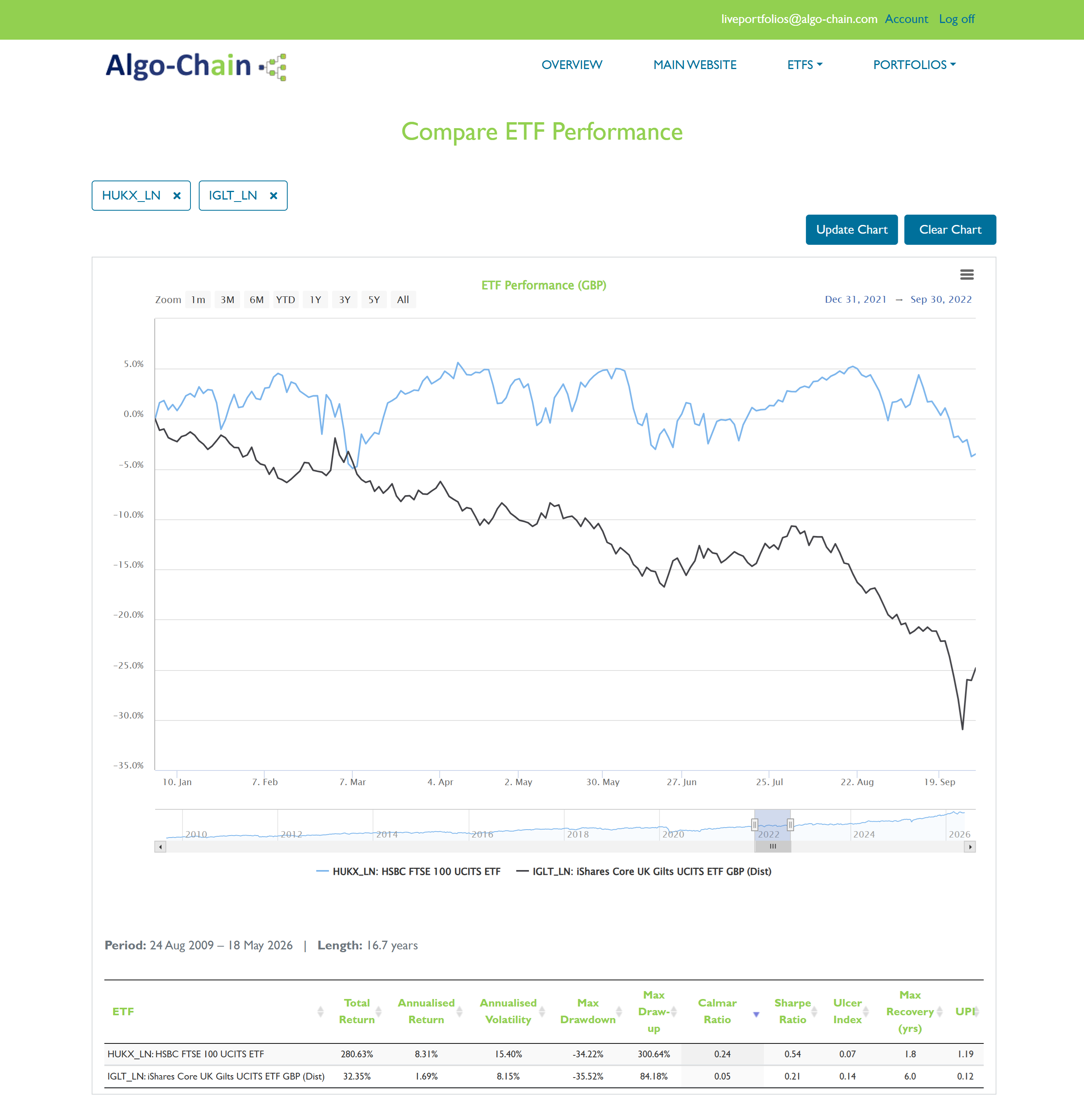 Figure 1 – This chart shows the extreme market moves during the summer of 2022 when both the UK Gilts market and
UK stock market suffered simultaneous losses
The Three Things Stress Events Actually Expose
Stress events don't just move prices; they reveal the hidden structural weaknesses and assumptions that go unnoticed in calmer markets.
Diversification isn't a permanent feature of a portfolio; it's dependent on the market regime. In growth-led selloffs, bonds usually act as ballast. But in inflation shocks, like 2022, bonds can become a second source of risk as rates drive the narrative. If you aren't testing your portfolio against multiple regime types, you are effectively betting that the next crisis will be a carbon copy of the last one.
While the maximum drawdown figure gets the headlines, the more significant commercial risk is the time-to-recovery. A sharp 15% drop that bounces back in months is a manageable client experience; a 12% drop that stays underwater for two years is relationship breaking. Stress testing must account for how long a client is required to stay patient, not just how much they might lose on paper.
When markets turn volatile, approximate explanations don't work. The firms with the greatest advantage are those who can explain exactly why a portfolio is behaving as it is, with component-level precision. This level of clarity cannot be improvised under fire, it requires a documented, rules-based framework that was built and understood long before the stress event arrived.
When Process Breaks Down: The Hidden Risks of Reactive Portfolio Management
There's a category of model portfolio that works quietly - until it doesn't. Built largely on judgement rather than structure, these portfolios rely on individual allocation calls, periodic rebalancing decisions, and a broad investment philosophy applied without a clearly documented framework. In stable markets, that can be enough. Performance may look reasonable, and the lack of structure is rarely tested.
But stress events change the rules. Without a defined, rules-based process, it becomes increasingly difficult to distinguish between a portfolio that is evolving because conditions triggered a pre-determined response and one that is simply reacting to price moves in real time. That distinction matters. One is process. The other is improvisation.
And improvisation tends to come late. By the time a reactive decision is made, the conditions that justified it have often already passed. Adjustments are made after the inflection point, not at it – and typically under greater pressure, with less clarity, and a higher emotional burden. What feels like responsiveness can, in practice, become a form of lag.
The final layer of risk is governance. Under the FCA's Consumer Duty - live for open products since 31 July 2023 and closed products since 31 July 2024 - it is no longer sufficient to simply hold a view on markets. Firms are expected to demonstrate how decisions were made. That means an auditable record: what scenarios were tested, what conclusions were drawn, and what actions were taken, or deliberately not taken, as a result.
A portfolio built on judgement alone can struggle to meet that standard. Not because the decisions are necessarily wrong, but because the rationale is often implicit rather than documented. And that is the real issue. When the next stress event arrives, the question will not just be how the portfolio performed. It will be whether the firm can clearly explain why it behaved the way it did and show that those outcomes were the result of a consistent, repeatable process, rather than decisions made in the moment.
The Litmus Test: What a Real Stress-Testing Framework Must Prove
A credible framework starts with a scenario set that covers more than one kind of shock. Testing for a 20% equity decline is a baseline. It is not, on its own, a meaningful stress test. At a minimum, a useful scenario set should include:
-
Equity -25% with rates +150bp
An inflation / tightening shock, consistent with 2022-style conditions
-
Equity -25% with rates -150bp
A growth shock — the 2008 / 2020 archetype
-
Credit spreads +300bp
Credit / liquidity stress
-
An FX shock
Where the portfolio carries material unhedged exposure
-
A liquidity event
With widened bid-offer assumptions and ETF premium/discount stress
For each scenario, the outputs that matter are the estimated loss, a recovery estimate range, the top three contributors at sleeve level, and a pre-defined governance action - rebalance, hold, or de-risk, with the documentation stub already drafted. Attribution matters as well. It needs to explain portfolio behaviour at the component level. Without that, a stress test tells you what happened. With it, it starts to tell you what to do differently. And finally, implementation reality must be built into the assumptions. Stress testing that ignores spreads, liquidity, ETF premium/discount behaviour, and the practical timing constraints around rebalancing may produce tidy numbers, but those numbers rarely survive contact with a real market.
The 10-Minute Audit: Is Your Investment Committee Prepared?
If an Investment Committee is asked, in the heat of a market crisis, to show its work within ten minutes, its response will instantly reveal whether it has a rules-based process or simply a collection of well-meaning opinions.
A committee operating a true strategy does not need to scramble for answers; the answers already exist in the IC pack. That pack should contain:
- Maximum drawdown and time-to-recovery for every core scenario.
- Contribution to drawdown broken down by sleeve and underlying holding.
- Real-time yield and duration contributions across the entire allocation.
- Scenario losses categorized by type (inflation, growth, policy, or liquidity).
- An honest look at turnover and transaction-cost drag, both YTD and rolling.
- A documented record of specific actions taken at every prior trigger point.
A committee that can produce this evidence is running a process. A committee that cannot is simply sharing an approach. The advantage of a rules-based process isn't that it magically eliminates drawdowns - nothing can do that. Its real value is that it makes portfolio behaviour predictable, explainable, and auditable.
Human judgement is not removed from this framework; it is elevated. Instead of being used to make frantic, reactive guesses under pressure, judgement is exercised to build the structure itself. This ensures that when the pressure is at its highest, your decisions remain consistent, documented, and - most importantly - defensible.
ETF-based model portfolios are the ideal vehicle for this disciplined approach. Their inherent transparency and liquidity allow for the kind of component-level attribution and cost-efficiency required to turn a general philosophy into a robust, industrial-strength process.
The next period of acute market stress isn't a matter of if, but when. The question to ask today is whether your process will hold up when the tide goes out. And whether you'll be able to prove to your clients, and the regulator, that you were ready for it.
If your firm is reviewing how portfolios would behave under severe stress scenarios, speak with our ETF Strategist team to explore structured stress-testing frameworks.
Existing platform users can stress test their portfolios directly within the Model Portfolio Platform.
Until next time.
Allan Lane